Top Left Link Buttons

2016

Yearly Archives

In Transaqua, A Dream Is Becoming Reality for Africa

Dec. 26 (EIRNS)—Decades-long efforts by the Transaqua authors and by the Schiller Institute have achieved a success, as Powerchina, the Lake Chad Basin Commission, and Nigerian authorities on Dec. 13 signed a Memorandum of Understanding for a water transfer project from the Congo Basin to Lake Chad. The project follows exactly the layout of Transaqua, the Italian project for a waterway from the Congo basin to the Lake Chad basin; it is aimed at replenishing Lake Chad and creating a Central Africa transport, energy, and agriculture infrastructure.

With this, the New Silk Road has reached Lake Chad!

According to a statement issued by the LCBC, the deal involves the initial stages of the Transaqua canal. Powerchina, the report says, will study the feasibility of “an African infrastructure project by opening a new corridor of development linking West and Central Africa, through:

  1. Potentially transferring 50 billion cubic meters annually to the Lake Chad through a series of dams in D.R.C., Republic of Congo and the Central African Republic.
  2. Potential to generate up to 15-25 billion kWh of hydroelectricity through the mass movement of the water by gravity.
  3. Potential to develop a series of irrigated areas for crops, or livestock over an area of 50,000 to 70,000 square km in the Sahel zone in Chad, northeast Nigeria, northern Cameroon and Niger.
  4. Creating an expanded economic zone by providing new infrastructure platforms of development in agriculture, industries, transportation, and electrical production, affecting up to 12 African nations.

The statement continues,

“The core idea is to increase the water quantity in the Lake Chad, improvement of water flow conditions, alleviate poverty within the basin through socio-economic activities, meet the energy needs of towns surrounding the two Congo, and to conduct an in-depth environmental impact assessment.”

Previous to the deal, detailed Terms of Reference and methodology for a feasibility study had been provided to the LCBC by a team of the Italian Bonifica engineering firm, led by engineers Marcello Vichi and Andrea Mangano, authors of the original Transaqua idea more than 35 years ago. LCBC Executive Secretary Abdullahi Sanusi Imran had acknowledged, in a communication to the Italians, that the Transaquaconcept “is much more appropriate for the situation of the Lake Chad than all other alternative solutions.” Both Vichi and Mangano had presented the idea at an EIR seminar in Frankfurt last March 23, with the participation of LCBC representative Mohammed Bila.

With Powerchina, a most powerful partner enters the constellation of forces. Powerchina is the Chinese state-owned company that built the Three Gorges Project, the largest hydropower project in the world.

In remarks reported by Nigerian media, the Vice-President of Powerchina, Mr. Tian Hailua, “explained that with the transfer of water to the lake, there is the potential to develop a series of irrigated areas for crops and livestock of over an area of 50,000 to 70,000 sq km in the basin.”

Nigerian Water Minister Suleiman Adamu”noted that the project is a generational project as it would take a long time to actualize, due to the huge capital involved and the complexity of the nature the project. He, however, called for concerted efforts from all to see that the project is achievable as this would save the livelihood of over 40 million people living within the basin.”

Although the volume of water transfer specified is half of the volume of the original Transaqua project to refill Lake Chad, it is expected that the Powerchina study will explore the feasibility of building a system of dams and waterways which can be extended southwards in the Democratic Republic of Congo, involving all the right-bank tributaries of the Congo River. In this way, the project will not only be a simple water transfer but also a major transport infrastructure connecting all nations of Central Africa.

“To be complete, the feasibility study should explore from the beginning the complete length of the water-transfer project,” Transaqua author Marcello Vichi stated, “even if the canal, obviously, should necessarily start from the north, in Central African territory, to proceed southwards as much as allowed by the available funds and by national will. The longer the canal, the bigger will be the water volume to be poured into the lake.


Statement by Zepp-LaRouche to the International Dubna Conference, Russia

This is an edited transcript of a video presentation by the founder of the Schiller Institute, Helga Zepp-LaRouche, to the Sixth Annual International Conference on Fundamental and Applied Problems of Sustained Development in the “Nature-Society-Man” System at the Dubna International University of Nature, Society, and Man, in Dubna, Moscow Region, Russian Federation. The conference—“Designing the World’s Future”—took place December 19-20, 2016. This video message was prerecorded on December 5, 2016.

Helga Zepp LaRouche: Dear participants in the Dubna Conference, dear Professor Bolshakov:

I feel very honored that you are allowing me to again address your conference, especially at this extremely dramatic and exciting moment in history. We are experiencing right now a world revolution. We are seeing the collapse of the paradigm of globalization, and it is maybe an irony of history that this paradigm only lasted about 25 years. It started to come into being with the disintegration of the Soviet Union in 1991, and it was characterized by the idea that there should be a unipolar world, and therefore that it would be legitimate to topple governments which would not submit to this unipolar world, by means of regime change, color revolution, or even wars based on lies, as we have seen so plentifully in the Middle East.

The economic side of this globalization went along with neo-liberal monetarism, which created the condition where the rich became so rich that they don’t know what to do with what they have accumulated; the middle class dropped into poverty; and for an increasing mass of poor people, they became so poor that despite many jobs or no job at all, they could not make ends meet.

This has been the reason that there was a revolt. First in June in Great Britain with the Brexit; this continued with the election of Donald Trump in the United States; and we just saw the “no” to the referendum in Italy, which had essentially the same reason: complete mistrust of the population against an establishment which has been completely out of sync with the interests of the common good and the common people. This revolution, I dare to predict, will continue until the injustices associated with it—which have killed many people either in war or by economic means—are corrected.

Alternative System Is Ready

The good news is that an alternative is already in place. You know that we were extremely engaged, in the same 25-year period, with the idea of building a Eurasian Land-Bridge, which we already in 1991 called the New Silk Road; that we have promoted this idea of a New World Economic Order based on principles of physical economy, as they were proposed by Mr. LaRouche for almost 50 years—that they should become the basis for a New World Economic Order.

Now after some many difficulties, finally, in September 2013, President Xi Jinping, in an address in Kazakhstan, put the New Silk Road on the international agenda. And what you have seen in the meantime is an unbelievable speed of cooperation among nations in Asia, but also in other parts of the world, all based on the principle of “win-win” cooperation, whereby naturally China is exporting the very successful Chinese model of economy. After all, China was able to develop its own economy in a period of only 30 years, to reach the point that the industrialized world needed almost 200 years to achieve. China is exporting this economic model, but it is doing so on the basis of a win-win conception; that is, the idea that all participating countries have equal benefits and advantages. It is the same idea as the Peace of Westphalia, that foreign policy can only succeed if it is in the interest of the “Other.”

I know that in the beginning, there was a certain amount of debate in Russia, about whether this would be against Russian interests. But in the meantime, I think a very successful process has developed. In the latest stage, at the Vladivostok Eastern Economic Forum in September, with the participation of [President Xi,] President Putin, Prime Minister Abe from Japan, and many others, and 2,500 delegates from many Asian countries, there was a big integration of the “One Belt, One Road” policy with the Eurasian Economic Union. That integration is moving forward very, very rapidly. It now already involves more than 100 nations and international institutions. It involves integration of infrastructure and high-technology cooperation, especially in the field of energy and nuclear energy; it involves space cooperation; and it has become a very attractive dynamic. After Vladivostok, this integration continued at the G-20 summit in Hangzhou; it followed with the ASEAN conference in Laos; then it went to Goa, to the BRICS annual conference, in India; and the latest example was the APEC conference in Peru, where many Latin American countries are now joining this development.

This is an economic model which is already reaching Europe, with the 16+1 countries of Central and Eastern Europe, which are now all cooperating with China on the development of infrastructure. But it is very clear that you cannot work with China from Central and Eastern Europe, without going through Russia, and without Russia being part of this, so that it becomes a real peace order. The EU has been extremely “stand-offish,” not taking up President Xi Jinping’s offer of win-win cooperation; they have also, naturally, not taken up President Putin’s many, many offers for cooperation in Eurasian integration from the Atlantic to the Pacific.

But now with the election of Donald Trump, there may be a change in the situation.

New Potentials

This is not yet decided, but it is a potential. One thing is very clear: If Hillary Clinton had been elected, we would in all likelihood have been on a very short road to World War III. Very hopefully, this is changing, because Trump already had phone conversations with President Putin and President Xi, and said that he wants to normalize the relationship between Russia and the United States. That obviously is not enough, but Trump had also promised that he would implement Glass-Steagall, the banking separation law of Franklin D. Roosevelt, and that he would invest, in his first 100 days in office, in a $1 trillion infrastructure program for the United States, to make the infrastructure in the United States the most modern in the world. To carry that out, he has a big job to do, given that the infrastructure in the United States is completely falling apart; but this is potentially the solution.

Because—after the Schiller Institute published the 370-page book, The New Silk Road Becomes the World Land-Bridge—we added one more chapter—namely that the United States must join the New Silk Road, because the United States needs a massive infrastructure program. Now President-Elect Trump may understand that, for good reason—because he is a businessman, and as President Putin just noted, he has been successful, and probably will find his new responsibilities on a higher level. And as Madame Fu Ying, chair of the Foreign Affairs Committee of the National People’s Congress, said recently at a conference in New York, the proposal by Trump for a U.S. infrastructure program can be a bridge to the New Silk Road and the “One Belt, One Road” policies. If that program can be successfully put on the agenda, there is indeed hope.

LaRouche’s ‘Four Laws’

Mr. LaRouche—who would have liked to also send you greetings, but he unfortunately has a severe cold right now, but he greets you anyhow—he has been emphasizing that the only way the world can get out of this present crisis requires at an absolute minimum, the implementation of his four basic laws.

The First Law is to go back to the banking separation of Glass-Steagall of Franklin D. Roosevelt, doing exactly what Roosevelt did in 1933: separating the investment banks from the commercial banks—to isolate the derivatives and the bad debt, the unpayable debt, and just stop the casino economy. If the investment banks have to close, that’s all the better, because we really don’t need this casino aspect of the economy.

The Second Law goes back to the idea of the National Bank, which first was defined by Alexander Hamilton, the first Secretary of the Treasury of the United States, and which basically implies the Third Law—the idea that a sovereign government has the right to issue credit, provided it only goes into productive investment. I think this is a very important point in Russia right now, because of the various economic heritages coming from the Yeltsin period, and the question of where the power to generate credit is located. I think this idea, for Russia, is extremely important: that the sovereign government has the right to issue credit—and I don’t mean money, I don’t mean reserves, I don’t mean paper money on the financial open markets—I mean something completely different. I’m saying that the sovereign government has the right to issue credit lines for investment in those areas of the economy in which you would also invest if the economy were in good shape. This was exactly what not only Alexander Hamilton did, but also what Lincoln did with the greenbacks, but especially what Franklin D. Roosevelt did, by creating the New Deal, where the Reconstruction Finance Corporation, after the Glass-Steagall Act was implemented, issued credits for huge, large-scale infrastructure projects such as the Tennessee Valley Authority project and others, and with that, took the United States out of the Depression and made it, by the end of the Second World War, the most prosperous nation in the world. And it was exactly the same kind of credit mechanism which was used in Germany in the postwar period by the Kreditanstalt für Wiederaufbau, to finance investment and the reconstruction of Germany. And this led to the Economic Miracle, which everybody admired, in only a few years time.

In 1931, there was a presentation by Dr. Wilhelm Lautenbach before the Reichsministerium in Germany, which essentially proposed what Roosevelt proposed two years later in the United States. What Dr. Lautenbach said, is that you have the coincidence of a world depression and a world currency crisis, and the usual market mechanisms do not function any more. The only way this can be addressed is by the state: The state has the right and the power to issue credit, and provided that credit goes into real production, based on physical principles, then it is not inflationary, and that is the only way you can get the economy going.

That would also function in Russia today; there is no question about it: It would work if people left the idea of “money,” and instead went to the idea of physical economy only. The Fourth Law, which LaRouche insists is absolutely crucial, is that you have to have a crash program for the development of fusion power and international space cooperation, because the world economy lacks qualitative increases in productivity as a result of the paradigm of globalization. Investment in basic research and development in the last 25 years was neglected to the point that the world economy today is not in a position to take care of the existing world population. And you can only remedy that by a gigantic leap in productivity, which must be the result of higher levels of energy flux-density in the production process, and the absolutely necessary next step in this direction is fusion power.

Thermonuclear fusion solves several problems at the same time, and as you know, breakthroughs were made with the stellarator in Greifswald in Germany during the past year, but also in the Chinese EAST model. All it needs is appropriate funding to get such a crash program to lead to the success and potential commercial use of fusion power. Fusion power would give you energy and raw materials security for the entire world, and it would also solve the problem of getting mankind a new form of propulsion for space travel, and in that way shorten the time tremendously, which is absolutely necessary if you want to go into longer spaceflights such as to Mars.

The Chinese are very advanced; for example, they want to land on the far side of the Moon next year, and they have invited many, many countries to join them in the Chinese Space Station, which will be ready in the year 2022. They intend to mine helium-3 from the far side of the Moon as a fuel for a fusion economy on the Earth.

This is all very exciting, and I think that the idea that mankind is the only creative species, and, as Mr. LaRouche has said many, many times, we are the only known creative species in the universe so far (that does not mean that we may not eventually find other intelligent beings from other galaxies, since there are about 2 trillion galaxies, so that’s a big question), but I think we are on the verge of a completely new paradigm. If we go now for the kinds of scientific breakthroughs which are on the level of Albert Einstein—the question of what is the role of man in the universe, and how can we think about ourselves, our creative mentation, as the most developed aspect of the universe—then we can change the identity of humanity so that we become truly adult, and that we work together. Geniuses of different nations and different cultures can easily work together, like astronauts, who understand the common aims of mankind which we must pursue, and not geopolitical aims.

I think we are on the verge of such a new paradigm. I think if we all act together now, to use this potential of hopefully changing the United States, getting new cooperation between the United States and Russia, moving to a completely new model of economy, what many people have called the common destiny or common future of the one mankind, I think we have a great future ahead of us.


Zepp-LaRouche in Copenhagen: Donald Trump and the New International Paradigm

On Monday, December 12, Helga Zepp-LaRouche was the special guest speaker at a Schiller Institute/EIR seminar in Copenhagen entitled, “Donald Trump and the New International Paradigm.” Eight diplomats from six countries attended, including two ambassadors. There were nations from Western Europe, Southwest Asia, Western and Eastern Asia, and Africa. In addition, there were around 30 Schiller Institute members and contacts, as well as a few representatives of various Danish and international institutions.


Helga Zepp-LaRouche Keynote to 23rd National Congress of the Association of Economists of Peru

Schiller Institute founder Helga Zepp-LaRouche delivered the following keynote address to the XXIII National Congress of the Association of Economists of Peru, held in Pucallpa, Ucayali, in the Amazon region of Peru. The title of the Nov. 17-19 congress is “The Peru-Brazil Bioceanic Train: Impact on the Economy of the Amazon Region and the Country,” and Zepp-LaRouche’s presentation, delivered at the opening session on Nov. 17, was on “The New Silk Road Concept, Facing the Collapse of the World Financial System.” The Peruvian Economists’ congress was timed to coincide with the Nov. 19-20 APEC summit in Lima, Peru, with the expected participation of numerous heads of states, including China’s Xi Jinping and Russia’s Vladimir Putin.


Open Letter from Chairman of the Progressive Socialist Party of Ukraine Natalia Vitrenko

Stop the Political Terror, Defend the Right to Life of Leaders of a Ukrainian Opposition Party!


To President of Ukraine P. Poroshenko

Prosecutor General of Ukraine Yu. Lutsenko

Chairman of the Security Service of Ukraine V. Hrytsak

Minister of Internal Affairs of Ukraine A. Avakov

Human Rights Ombudsmen of the Supreme Rada of Ukraine V. Lutkovska

Chairman of the Supreme Rada of Ukraine Committee on Human Rights, National Minorities and Ethnic Relations H. Nemyria

Representative office of the OSCE in Ukraine

Representative office of the European Union in Ukraine

Embassy of the United States of America in Ukraine

Embassy of the Federal Republic of Germany in Ukraine

Embassy of France in Ukraine

Embassy of Italy in Ukraine

Embassy of the Republic of Poland in Ukraine

Embassy of the Russian Federation in Ukraine

Embassy of the Republic of Belarus in Ukraine

Embassy of Israel in Ukraine


Stop the Political Terror, Defend the Right to Life of Leaders of a Ukrainian Opposition Party!

Open Letter from Chairman of the Progressive Socialist Party of Ukraine Natalia Vitrenko

2 November 2016

I am compelled to ask you to defend the political rights of members of the Progressive Socialist Party of Ukraine (PSPU), which have been grossly violated, and to seek a halt to actions impeding the lawful activity of our party.

On 28 October 2016 at 16:30, a group of unknown persons, among whom were fighters of the Azov Battalion under the direction of A.E. Shatilin, forcibly seized the premises located at 3/7 Podgornaya/Tatarskaya St., Kyiv, which legally belong to Siver Ukraina LLC. These property rights were established by decision #18/519 of the Kyiv Commercial Court, dated 22 July 2003, and have not been revoked by any party up through the present time.

Since 2005 the PSPU has rented a part of the premises at the aforementioned address from Siver Ukraina LLC on the basis of a lease contract. In full compliance with the law and the lease contract, the PSPU makes the required payments.  The contractual relations between the PSPU and Siver Ukraina LLC have not been revoked by any party.

The PSPU kept its party documents, including the originals of the Charter and Program of the PSPU, proceedings of its congresses, plenary sessions of its Central Committee, and sessions of the Presidium of its Central Committee, as well as the party archives, emblems and literature, in these rented premises. The party papers included the registration documents of the local, district and regional party organizations; the personal data of the local and central party leadership; originals and copies of numerous court rulings made during the 20 years in which the PSPU has been active; a large quantity of photo and video material from throughout the years in which the party has existed; computer and duplicating equipment; cameras and video recorders; household appliances; and personal property belonging to me, the chairman of the PSPU and a People’s Deputy of Ukraine in two convocations, to V. Marchenko, deputy chairman of the PSPU and a People’s Deputy of Ukraine in three convocations, and to several other party members. In addition, the rented premises housed our unique historical, legal, economic, political, sociological and statistics library; records related to meetings with citizens on personal issues; my scientific and analytical working papers (as a professional economist, a doctor of economics); and papers belonging to the editor-in-chief of the PSPU newspaper Dosvitni ogni, which are needed by V. Marchenko for his work as a journalist.

I note that neither the SBU [Security Service of Ukraine] nor the MVD [Internal Affairs Ministry] has made any claims of crimes against myself or V. Marchenko and has not initiated proceedings on such matters.

In the absence of a court decision authorizing eviction from the premises and in the absence of any officer of a court, what occurred on Friday, 28 October 2016 was a forcible seizure of the entire premises owned by Siver Ukraina LLC, including the premises rented by the PSPU. That is, there took place in addition an illegal seizure of the property, documents, equipment, literature and emblems of the PSPU.

A.E. Shatilin stated on Saturday, 29 October 2016 that the SBU had conducted a search in the Siver Ukrainia LLC premises, including the PSPU premises, and had removed two busloads of property, documents, literature, computer equipment, and so forth, which were essentially stolen from us. No warrants for the search and seizure of documents or party and personal property have been presented either to the owner of the premises, Siver Ukraina LLC, or to me as chairman of the PSPU.

I emphasize that on Friday, 28 October 2016, when the forcible seizure of our premises was carried out, I personally demanded of police officers and of investigator D. Soroka that they ensure the security and safe-keeping of our party property, documents, literature and equipment, as well as the personal possessions of the PSPU’s leaders and members. That is, to prevent outside parties from entering the premises rented by us. My demand was ignored, and the law enforcement agencies did not defend our rights.

On Monday, 31 October 2016, I personally, V. Marchenko, and representatives of other renters were barred from entering our places of work. We were compelled again to summon the police from the Shevchenko District of Kyiv, who recorded this instance of violation of the law.

I believe that the illegal seizure of the Siver Ukraina LLC premises and the entry into the premises leased by the PSPU were committed for the purpose of impeding the political activity of the PSPU, an opposition party, and of fishing for spurious grounds on which to ban our party, launch criminal prosecutions of myself and V. Marchenko as leaders of the party, and intimidate members of the PSPU and of society as a whole.

This political action is aimed at suppressing the freedom of speech and the freedom of thought and beliefs, and at legalizing dictatorial forms of combating the opposition. The harassment of the PSPU and the unlawful inaction of Ukrainian law enforcement agencies are particularly distinguished by the circumstances not only that the PSPU on reasonable ground criticizes the government’s socioeconomic and foreign policy, but also that our party takes an anti-fascist position and openly, providing evidence and invoking the norms and principles of international law, publicizes the collaboration of members of the OUN-UPA [Organization of Ukrainian Nationalists and Ukrainian Insurgent Army] with Nazi Germany and exposes their crimes during the occupation of Ukraine by Hitler’s forces.

The inaction of the law enforcement agencies and the free hand allowed to the Azov fighters portend, in addition to a political crackdown on the PSPU, the threat of physical elimination of myself, V. Marchenko, and core PSPU activists.

Please give your urgent attention to this appeal, and defend the Progressive Socialist Party of Ukraine against discrimination and unlawful infringements on the part of agencies of state power and of radical guerrillas; I ask you, as well, to ensure the right of the citizens of Ukraine to take part in the lawful activity of the PSPU on the basis of the Constitution of Ukraine, the Law of Ukraine “On Political Parties of Ukraine,” and the European Convention for the Protection of Human Rights and Fundamental Freedoms. I ask you to ensure the personal security of myself, V. Marchenko and members of the PSPU.


Chairman of the PSPU                                                           Natalia Vitrenko


Appeal to the United Nations General Assembly: A New Paradigm for the Common Aims of Mankind!

by Helga Zepp-LaRouche

It is crucial that the General Assembly of the United Nations now convening in New York, build on the progress that the G20 Summit has achieved under China’s leadership. The course has been set toward a new financial architecture, and the chance is greater than ever that all nations can participate in the building of the New Silk Road on the basis of win-win cooperation, and that the productivity of the world economy will rise on the basis of innovation, while poverty and the consequences of war are overcome. The main problem, however, is that the West continues to cling to the status quo of a uni-polar world and the neo-liberal financial system, although both of those objectives have long been unachievable. The rise of Asia signifies that one nation cannot set the rules, but that solutions must be found through dialogue and negotiation. The neo-liberal system is in the throes of an existential crisis.

The first twin of globalization—the policy of regime-change and alleged humanitarian interventions—has cost the lives of millions of people, brought untold suffering to millions more, destroyed entire regions, created the breeding grounds for the spread of terrorism, and set off huge waves of refugees. The wars against Iraq and Afghanistan alone, according to the study of Professor Neta Crawford of Brown University, have cost five trillion dollars—and for what result?

The second twin of globalization—the system of maximum profit for the TBTF banks, which are supposedly “too big to be allowed to fail”—has led to an unbearable gap between rich and poor. And if certain banks have to pay the full sum of their fines for criminal methods, they must declare bankruptcy because their capital base is insufficient. Hence, a new meltdown threatens, with even more catastrophic consequences than the collapse of Lehman Brothers in 2008, now that central bank instruments are exhausted and no longer effective.

In that context, two reports released in Great Britain offer an extraordinary opportunity to re-assess and correct the current policy. After the Chilcot Report, which laid the blame on Tony Blair for the illegal Iraq war which was built on lies, a commission of the British Parliament has levelled no less scathing charges against former Prime Minister David Cameron for the war in Libya, which was carried out on “erroneous assumptions” and led to“political and economic collapse, inter-militia and inter-tribal warfare, humanitarian and migrant crises, widespread human rights violations, the spread of Gaddafi regime weapons across the region and the growth of ISIL in North Africa.”

On the role of the United States, the report states that“The United States was instrumental in extending the terms of Resolution 1973 beyond the imposition of a no-fly zone to include the authorisation of ‘all necessary measures’ to protect civilians. In practice, this led to the imposition of a ‘no-drive zone’ and the assumed authority to attack the entire Libyan Government command and communications network.”

That same overall review of the current policy should, of course, include the implications of the 28 pages of the official Joint Congressional Inquiry Report, which deals with the circumstances of the attacks of September 11, 2001, as well as the JASTA bill, which necessitate a completely new investigation.

In light of the horrendous suffering this failed policy has caused: the millions of dead and injured; the traumatized children and soldiers (including in the nations waging war); the destruction of cities, villages, infrastructure and irreplaceable cultural wealth; it is not only appropriate, but a moral obligation for the countries that took part in these wars in the different “coalitions of the willing,” to examine the political process in their parliaments and to fully participate in the reconstruction of the regions that have been devastated. This will not bring the dead back to life, but the admission of guilt and a genuine change of policy towards development would give the people living there today hope for a future.

The status quo cannot be maintained. As a result of both twins of globalization, there has been an enormous loss of trust among the population in the trans-Atlantic world. Right-wing populist and right-extremist parties are massively gaining strength; the conditions of the 1930s threaten to reappear in a new form; the European Union is crumbling; and the refugee crisis will not be solved by securing the external EU borders, but only relocated and removed from the news. The U.S. economy is collapsing, while the society is more than ever torn and overtaken by violence. Either this process will lead to an escalation of the confrontation with Russia and China, and to the extermination of mankind in a great war, or the leading politicians in the West will have the moral integrity to correct the errors of the past.

The Solution

To come back to the positive proposition in the beginning of this appeal, the course has been set toward a way out of this crisis of civilization since the G20 summit. Not only has China presented a new level of cooperation based not on geopolitics, but rather on a policy in the mutual interest of all, it has also pledged to industrialize Africa and other low-income countries, an approach that could both solve the refugee crisis and eliminate the terrorist environment. Clearly, the extension of the New Silk Road to the Middle East and Africa both requires and will bring about growth rates of 7 to 10%.

And just as promptly, the Club of Rome stepped in with a new report under the cynical title in the German translation of “One Percent Is Enough,” which would lead in consequence to population reduction, a fascist policy for which the Club of Rome is infamous. The UN recently stressed that Africa needs a growth rate of at least 7-8%. When one of the authors of the Club of Rome report, the Norwegian Jorgen Randers, comes out with the absurd statement, “My daughter is the most dangerous animal in the world,” because she consumes 30 times more energy than a girl in a developing country, it serves to show on what image of man the Club of Rome bases its argument, i.e. on a bestial one.

But man, in contrast to all other creatures, is able to use his creative potential to continually discover new insights into the laws of the universe; this is called scientific progress. The unlimited process of perfecting the human mind has a correspondence in the laws of the physical universe, which develops to ever higher energy-flux densities. We are not in a closed system on the Earth—as the Club of Rome and similar organizations claim—rather, our planet is an integral part of the Solar System, the galaxy and the universe, about which space research is discovering more and more. This research yields many advantages for Earth itself, and it is therefore fantastic that China announced at the G20 summit, that it would share with developing countries the most advanced research results for their space and lunar exploration projects.

Mankind has arrived at a crossroads. If we continue to walk the well-trodden paths with a policy of “more of the same,” the world threatens to come apart. If, on the contrary, we can agree on the common aims of mankind—an economic and financial order that serves the well-being of all mankind, and which makes possible a decent life for every person on this Earth; the securing of raw materials and energy through higher technologies such as thermonuclear fusion; the exploration of space to safeguard our planet and a renaissance of classical cultures—then we will be able to usher in a new, better era in the history of our species.

The General Assembly of the United Nations is the fitting place, where the new paradigm of our one mankind, based on that which comes before all the differences among nations, must be established and celebrated.


Appeal to the United Nations General Assembly: A New Paradigm for the Common Aims of Mankind!

by Helga Zepp-LaRouche

It is crucial that the General Assembly of the United Nations now convening in New York, build on the progress that the G20 Summit has achieved under China’s leadership. The course has been set toward a new financial architecture, and the chance is greater than ever that all nations can participate in the building of the New Silk Road on the basis of win-win cooperation, and that the productivity of the world economy will rise on the basis of innovation, while poverty and the consequences of war are overcome. The main problem, however, is that the West continues to cling to the status quo of a uni-polar world and the neo-liberal financial system, although both of those objectives have long been unachievable. The rise of Asia signifies that one nation cannot set the rules, but that solutions must be found through dialogue and negotiation. The neo-liberal system is in the throes of an existential crisis.

The first twin of globalization—the policy of regime-change and alleged humanitarian interventions—has cost the lives of millions of people, brought untold suffering to millions more, destroyed entire regions, created the breeding grounds for the spread of terrorism, and set off huge waves of refugees. The wars against Iraq and Afghanistan alone, according to the study of Professor Neta Crawford of Brown University, have cost five trillion dollars—and for what result?

The second twin of globalization—the system of maximum profit for the TBTF banks, which are supposedly “too big to be allowed to fail”—has led to an unbearable gap between rich and poor. And if certain banks have to pay the full sum of their fines for criminal methods, they must declare bankruptcy because their capital base is insufficient. Hence, a new meltdown threatens, with even more catastrophic consequences than the collapse of Lehman Brothers in 2008, now that central bank instruments are exhausted and no longer effective.

In that context, two reports released in Great Britain offer an extraordinary opportunity to re-assess and correct the current policy. After the Chilcot Report, which laid the blame on Tony Blair for the illegal Iraq war which was built on lies, a commission of the British Parliament has levelled no less scathing charges against former Prime Minister David Cameron for the war in Libya, which was carried out on “erroneous assumptions” and led to“political and economic collapse, inter-militia and inter-tribal warfare, humanitarian and migrant crises, widespread human rights violations, the spread of Gaddafi regime weapons across the region and the growth of ISIL in North Africa.”

On the role of the United States, the report states that“The United States was instrumental in extending the terms of Resolution 1973 beyond the imposition of a no-fly zone to include the authorisation of ‘all necessary measures’ to protect civilians. In practice, this led to the imposition of a ‘no-drive zone’ and the assumed authority to attack the entire Libyan Government command and communications network.”

That same overall review of the current policy should, of course, include the implications of the 28 pages of the official Joint Congressional Inquiry Report, which deals with the circumstances of the attacks of September 11, 2001, as well as the JASTA bill, which necessitate a completely new investigation.

In light of the horrendous suffering this failed policy has caused: the millions of dead and injured; the traumatized children and soldiers (including in the nations waging war); the destruction of cities, villages, infrastructure and irreplaceable cultural wealth; it is not only appropriate, but a moral obligation for the countries that took part in these wars in the different “coalitions of the willing,” to examine the political process in their parliaments and to fully participate in the reconstruction of the regions that have been devastated. This will not bring the dead back to life, but the admission of guilt and a genuine change of policy towards development would give the people living there today hope for a future.

The status quo cannot be maintained. As a result of both twins of globalization, there has been an enormous loss of trust among the population in the trans-Atlantic world. Right-wing populist and right-extremist parties are massively gaining strength; the conditions of the 1930s threaten to reappear in a new form; the European Union is crumbling; and the refugee crisis will not be solved by securing the external EU borders, but only relocated and removed from the news. The U.S. economy is collapsing, while the society is more than ever torn and overtaken by violence. Either this process will lead to an escalation of the confrontation with Russia and China, and to the extermination of mankind in a great war, or the leading politicians in the West will have the moral integrity to correct the errors of the past.

The Solution

To come back to the positive proposition in the beginning of this appeal, the course has been set toward a way out of this crisis of civilization since the G20 summit. Not only has China presented a new level of cooperation based not on geopolitics, but rather on a policy in the mutual interest of all, it has also pledged to industrialize Africa and other low-income countries, an approach that could both solve the refugee crisis and eliminate the terrorist environment. Clearly, the extension of the New Silk Road to the Middle East and Africa both requires and will bring about growth rates of 7 to 10%.

And just as promptly, the Club of Rome stepped in with a new report under the cynical title in the German translation of “One Percent Is Enough,” which would lead in consequence to population reduction, a fascist policy for which the Club of Rome is infamous. The UN recently stressed that Africa needs a growth rate of at least 7-8%. When one of the authors of the Club of Rome report, the Norwegian Jorgen Randers, comes out with the absurd statement, “My daughter is the most dangerous animal in the world,” because she consumes 30 times more energy than a girl in a developing country, it serves to show on what image of man the Club of Rome bases its argument, i.e. on a bestial one.

But man, in contrast to all other creatures, is able to use his creative potential to continually discover new insights into the laws of the universe; this is called scientific progress. The unlimited process of perfecting the human mind has a correspondence in the laws of the physical universe, which develops to ever higher energy-flux densities. We are not in a closed system on the Earth—as the Club of Rome and similar organizations claim—rather, our planet is an integral part of the Solar System, the galaxy and the universe, about which space research is discovering more and more. This research yields many advantages for Earth itself, and it is therefore fantastic that China announced at the G20 summit, that it would share with developing countries the most advanced research results for their space and lunar exploration projects.

Mankind has arrived at a crossroads. If we continue to walk the well-trodden paths with a policy of “more of the same,” the world threatens to come apart. If, on the contrary, we can agree on the common aims of mankind—an economic and financial order that serves the well-being of all mankind, and which makes possible a decent life for every person on this Earth; the securing of raw materials and energy through higher technologies such as thermonuclear fusion; the exploration of space to safeguard our planet and a renaissance of classical cultures—then we will be able to usher in a new, better era in the history of our species.

The General Assembly of the United Nations is the fitting place, where the new paradigm of our one mankind, based on that which comes before all the differences among nations, must be established and celebrated.


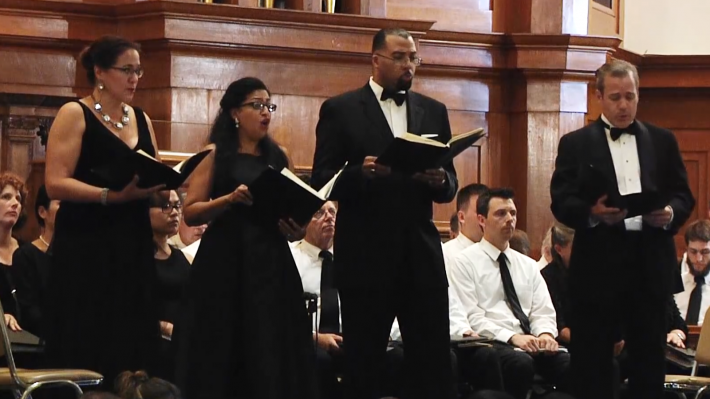
9/11 Memorial Concert


This concert, held at the Presbyterian Church in Morristown, NJ was the fourth of four “9/11 Living Memorial Concerts” to honor all the victims of 9/11 and its aftermath.

Lynn Yen, the executive director of the Foundation for the Revival of Classical Culture (FFTROCC) opened the event, discussing the importance of the occasion, and why the Schiller Institute chose to perform the four African American Spirituals, the Mozart “Requiem” and the Handel “Amen” chorus at the concert. She also introduced Jose Vega, a student with the Foundation, two Islamic leaders in the audience, and Terry Strada, of the 911 Families and a tireless fighter for Justice. Ms. Strada received a standing ovation for her work.

Lynn Yen introduced Terry Strada, saying,” At this point I would like to introduce somebody very special to all of you. Many of you probably know of her. Her name is Terry Strada. She is the national chairwoman of the 9/11 Families United for Justice Against Terrorism. She and her organization were instrumental in the release of the 28 pages of the congressional report on 9/11. Without further ado, I’m going to turn the microphone over to her.”

Address by Terry Strada: 9/11 Families United for Justice Against Terrorism

Terry Strada addressed the hundreds of concert attendees in the church, which was full: “Thank you! Thank you very much! My name is Terry Strada, and I lost my husband on September 11th, 2001. Tom was 41 years old when he went to work that day, and never came home again. We have three children. At the time, they were 7 years old, 4 years old, and our youngest was only 4 days old.

terry_strada-lynn_yen-morristown-crop

Terry Strada, left, and Lynn Yen

“On September 12th, 2001 I woke up — well, I probably didn’t sleep that night — so when the sun came up, the questions were, “Who did this? Why would they do this?”, and “How could they possibly do this? How could they attack our country like this, and how could they kill so many innocent people in one day?”

“Because I wanted to know the answers, I started to ask the questions more and more. And so did more and more 9/11 families. United to Bankrupt Terrorism was our first title, and now we’re United Together for Justice Against Terrorism. Of course it was the 28 pages that we focused on in the beginning that needed to be released. And when they were released, there were two key things that we learned. One, is that Saudi Arabia has never been fully investigated for the role that they played in 9/11; and two, that it is indisputable that the Saudis played a very important role in 9/11.

The second piece of legislation that I’ve been working on for over four years now, is called the Justice Against Sponsors of Terrorism Act. This bill is intended to fix a minor problem in our current Foreign Sovereignty Immunity Act of 1976. So, it’s a 40-year-old law that has stood for 40 years, until we looked further into the Saudi’s role in 9/11, found the evidence, and tried to hold them accountable.

“What happened next was that the courts decided to misinterpret the law and dismiss them on sovereign immunity. Make no mistake. No country, no entity, no individual is entitled to immunity — sovereign immunity, any type of immunity — in the case of a terrorist act. This bill is intended to hold any nation accountable for a terrorist attack on U.S. soil that kills United States citizens.

We’ve chosen this path because it’s a peaceful way to fight terrorism. We don’t want to see more bloodshed; we don’t ever want to see more people die over 9/11. And we also want to protect our borders; we want to protect our country; we want to protect you; I want to protect my children. And the way that we do this, is by holding the nations accountable that fund known terrorist organizations, like al-Qaeda, ISIS, Boko Haram.

People say, “You can’t fight the lone wolf.” I say, “Yes, we can!” If we cut off the funding, and we destroy their capabilities to recruit and incite, and bring on more terror and to brainwash people, we can eliminate ISIS. And that is our long-term goal. The short-term goal, right now, is to get Saudi Arabia off of this crazy [situation] that they’re not held accountable.

“In May, the Senate passed unanimously this Bill, and on Friday, September 9th, it went to the U.S. House of Representatives. I was in the gallery and was honored and proud to see each and every one of our 435 Members in the House vote “Yes” for JASTA. [applause] Thank you, thank you. I don’t really know how many times this has ever happened on our history, that we have both Chambers of Congress voting “Yes” unanimously. What this means for the President: as of 4:00 today, he was still threatening to veto the Bill. The Bill will be sent over to his office for signature later on tonight, at the latest tomorrow. We’re doing everything we can to convince him to not do this.

You probably hear things in the news — and I’ll kind of wrap this up, because I want to hear the music as badly as you do — but you may hear in the news, things about the Bill. They’re simply not true, if they’re coming from the Administration. Unfortunately, they are the mouthpiece for the Saudis at this point. We just need to point out to them how important this is, to hold them accountable — any nation, going forward — would be held accountable, and how important it is for our country to have that type of security net.

“If the President does decide to veto this Bill, it will be our last hurdle; it may be our biggest. But we plan to overcome it, and override the veto. Hopefully the Senate and the House will fall into line and do that for us.

“If there’s anything that you’d like to do to help, going forward, it’s PassJasta.Org.  That’s our website. It’s updated as often as I can get to a computer and update it. There are usually just simple instructions of how you can reach out to the White House, your Representative, or a co-sponsor of the bill. This is very important legislation. I thank you very much for taking the time to listen to me, and now I’m so honored to have these wonderful musicians. I have heard them practice. You are in for a treat. This is going to be a very wonderful time now for us to just transcend ourselves from the evil, to a higher place — to a place where Good is. I believe Good will win, and I thank you for coming.”


Strategic Seminar

June 8, 2016San Francisco Embarcadero Center

The Schiller Institute’s Strategic Seminar in San Franciso on June 8, drew 70 guests and experts to discuss the urgent topic “Will the U.S. Join the New Silk Road? Global Scientific Development or Nuclear War.” That question is to join the One Belt, One Road world infrastructure plan put forward by China, or stick with the collapsing Western economies, whose bankruptcy is fueling the danger of a global nuclear war.


Interview with Helga Zepp-LaRouche — U.S., Europe Need New Silk Road Cooperation More Than Asia Does


Schiller Institute founder Helga Zepp-LaRouche, called the “Silk Road Lady” in China and the first promoter with Lyndon LaRouche of this policy in Europe, was interviewed by TASS May 31, 2016 on the decision for a new global war or for economic development and cooperation.

TASS: How would you assess the current international cooperation?

Zepp-LaRouche: There are two completely different dynamics on the planet right now. On the one side you have the convergence of President Putin’s very successful military flanks, such as his intervention in Syria, which created the potential for peace, combined with his various diplomatic interventions in Asia, parallel to the Chinese New Silk Road initiatives.

These efforts represent a win-win perspective for over seventy participating countries already.

On the other side there is an extremely dangerous confrontation from the side of the United States, Great Britain, the EU and NATO against Russia and China, which has brought the world to a multiple crisis, more dangerous than at the height of the Cold War.

TASS: In what areas it is more active and where it is not?

Zepp-LaRouche:In the case of Syria the cooperation between Foreign Minister Lavrov and Secretary of State Kerry, as well as the Geneva cooperation between Russia and the U.S., is very positive. However, as long as the United States do not abandon their policy of regime change, the situation remains dangerous. President Putin has proven to be a brilliant strategist.

This allows confidence that the warhawks in NATO will not succeed to lure Russia into a trap, giving them a pretext for a preventive attack.

TASS: What are the issues we need to step up cooperation between the West and Russia? Why?

Zepp-LaRouche: The reality is, that the entire trans-Atlantic sector is bankrupt and about to blow up in a bigger way than in 2008. Japanese Prime Minister Abe, after a very important visit in Russia, made that point at the recent G7 meeting emphatically, but was rebuffed by President Obama, who insisted, that “the recovery is improving”, which is absurd in light of the negative interest rates of the central banks and the debate around “helicopter money”.

Therefore the West needs, more than Asia, the kind of economic cooperation of the One Road One Belt/Eurasian Economic Union cooperation, integrating Eurasia from Vladivostok to Lisbon, but also inviting the U.S. to participate in this perspective. The only way a catastrophe can be avoided, is if we succeed to overcome geopolitics and reach a new paradigm, based on a global development partnership and the common aims of mankind.

TASS: Why, despite the obvious threat of terrorism, cybercrime and other international challenges, does the West so hinder cooperation with Russia?

Zepp-LaRouche: Almost all important conflicts derive from the effort of the Anglo-American empire to maintain an unipolar world, at a point, where it has de facto ceased to exist already. More and more forces in the world realize that they have to make existential decisions, and that the interests of their nations are much better served by stopping sanctions and confrontation against Russia and China.

The fact that Russia and China have created a very strong strategic partnership, with India a third partner, has shifted the strategic balance in the world. More and more countries are seeing it as more beneficial to cooperate for joint development, than to be under the yoke of military confrontation. We are at a branching point in history, and at such moments, what counts is leadership of the kind we have seen from President Putin.

Source: http://tass.ru/mezhdunarodnaya-panorama/3325807


Page 1 of 212